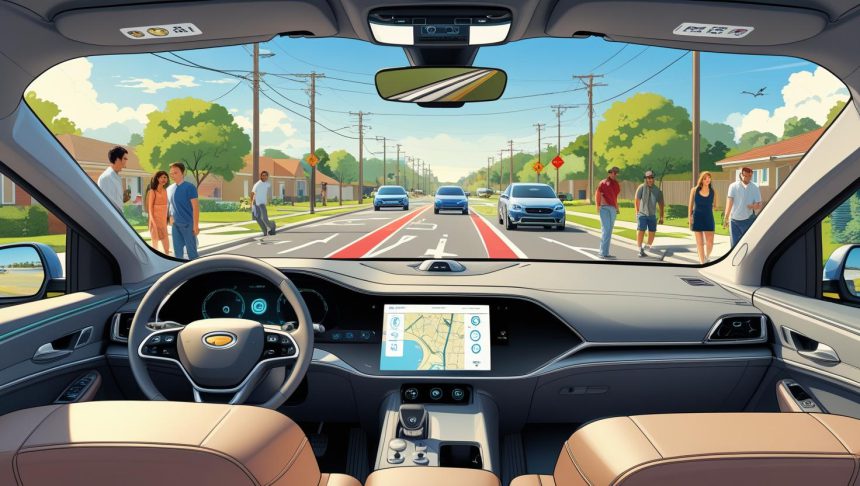
Functional Model of a Self-Driving Car Control System
Autonomous driving is no longer science fiction—it’s a complex choreography of sensors, algorithms, and actuators working in harmony. At the heart of every self-driving vehicle lies a functional model: a layered control system that turns raw data into safe, smooth motion. In this post, we’ll break down the key subsystems, explore how they interact, and highlight the challenges engineers solve at each stage.
1. Perception and Sensor Fusion
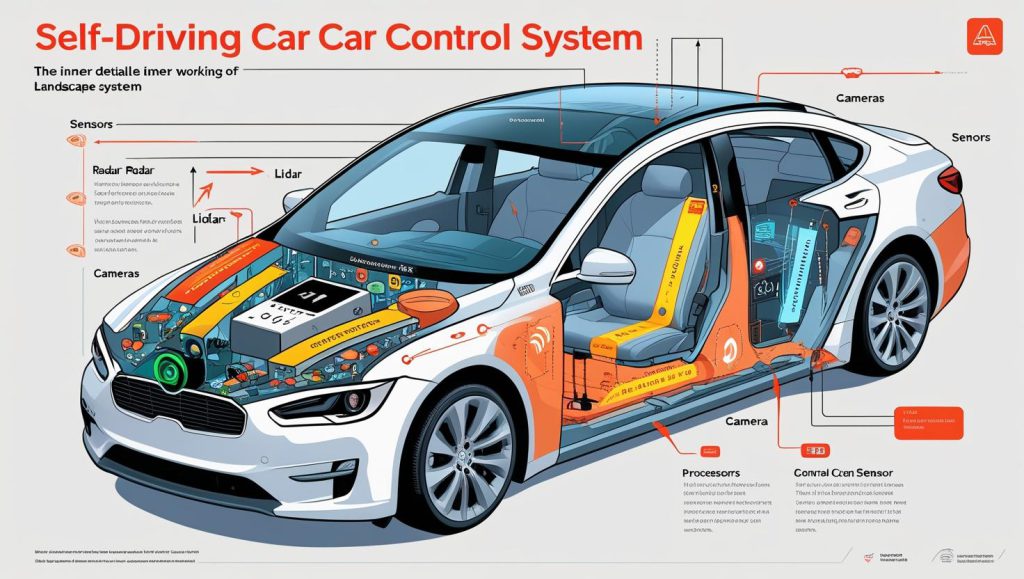
Self-driving cars rely on a suite of sensors to “see” their surroundings:
- Cameras: Provide high-resolution imagery for lane detection, object classification, and traffic-sign recognition.
- LiDAR: Emits laser pulses to build precise 3D point clouds, capturing vehicle-to-object distances with centimeter accuracy.
- Radar: Penetrates fog, rain, and dust to detect the speed and range of objects, crucial for adaptive cruise and collision-avoidance.
- Ultrasonic Sensors: Monitor short-range obstacles, especially useful during parking maneuvers.
All these streams feed into a sensor-fusion module, which aligns timestamps, compensates for individual sensor blind spots, and outputs a unified, real-time view of lane markings, pedestrians, cyclists, and other vehicles.
Image Suggestion: An infographic showing cameras, LiDAR, radar, and ultrasonic sensors mounted around a car.
2. Localization and Mapping
Knowing “where” you are is as important as knowing “what” is around you:
- High-Definition Maps (HD Maps): Pre-built with centimeter-level detail, these maps include road geometry, lane boundaries, traffic signs, and signal locations.
- Simultaneous Localization and Mapping (SLAM): While sensors continuously scan the environment, SLAM algorithms refine the vehicle’s position relative to the HD map, accounting for GPS drift and unexpected changes (e.g., construction zones).
- Inertial Measurement Unit (IMU): Tracks acceleration and rotation to maintain accurate positioning between GPS updates.
Together, they deliver a precise, up-to-date location estimate—critical for safe lane keeping and maneuver planning.
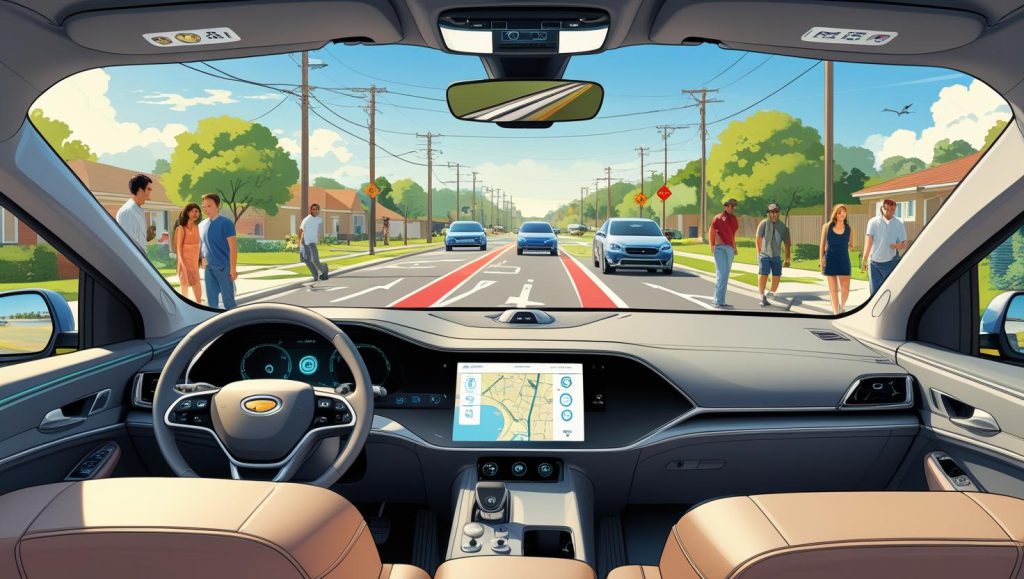
3. Path Planning
Once the world is perceived and the car knows its position, it must decide how to move:
- Global Planner: Charts the overall route from origin to destination using road networks and traffic data.
- Behavior Planner: Chooses maneuvers—lane changes, turns, overtakes—based on traffic rules, vehicle speed, and dynamic obstacles.
- Local Planner: Generates smooth, collision-free trajectories in real time, accounting for vehicle dynamics (e.g., maximum steering angle, braking limits) and comfort constraints (avoiding sudden jolts).
The planning stack continually updates as new sensor data arrives, ensuring the car can react to unexpected events like debris on the road or abrupt lane merges.
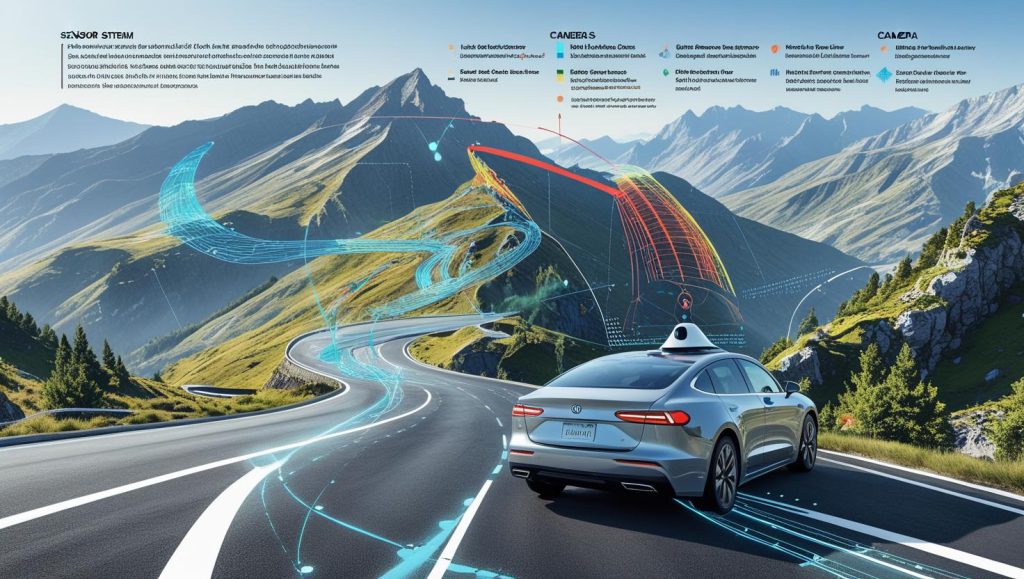
Image Suggestion: A screenshot of a planning algorithm visualizing multiple candidate trajectories overlaid on a road.
4. Decision Making and Behavior Arbitration
Complex urban scenarios demand more than pre-computed paths—they require split-second decisions:
- Finite State Machines (FSMs): Define discrete driving states (e.g., “Follow Lane,” “Yield to Pedestrian,” “Stop at Signal”).
- Rule-Based Logic: Encodes traffic laws and right-of-way hierarchies—for example, always stop at red lights or yield to emergency vehicles.
- Machine Learning Models: Predict the intent of other road users (e.g., “Is that cyclist about to turn?”) and adapt behavior accordingly.
A behavior arbiter reconciles conflicting signals—should the car speed up to beat a closing gap or brake to maintain distance? The final decision balances safety, legality, and passenger comfort.
5. Vehicle Control and Actuation
Translating planned trajectories into real-world motion involves:
- Longitudinal Control: Manages throttle and braking to maintain desired speed and safe following distances. Proportional–Integral–Derivative (PID) controllers or Model Predictive Control (MPC) are common.
- Lateral Control: Steers the wheels to stay centered in the lane or follow curved paths. Pure pursuit and Stanley methods are popular algorithms.
- Actuator Interfaces: Electronic control units send precise commands to the powertrain, braking system, and electric power steering.
Real-time feedback loops ensure the car adheres to its intended path, correcting for wind, road camber, or sensor noise.
6. Safety, Redundancy, and Monitoring
No single sensor or algorithm is infallible. Robust self-driving systems incorporate:
- Redundant Sensors and CPUs: Multiple hardware pathways ensure that a single failure doesn’t incapacitate the vehicle.
- Health Monitoring: Continuous diagnostics check sensor data consistency, CPU utilization, and network latency.
- Fallback Strategies: If perception falters (e.g., heavy fog obscures cameras), the system degrades gracefully—slowing down, pulling over, or handing control back to a human driver.
Safety is designed in layers, from hardware isolation to software watchdogs, ensuring the car can detect and mitigate its own faults.
Conclusion
Building a self-driving car control system is an exercise in systems engineering: integrating perception, localization, planning, decision-making, control, and safety into a cohesive whole. Each layer must work flawlessly with the rest, under real-world stresses, to transport passengers safely.
By understanding this functional model, you gain insight into why autonomous vehicles remain one of the most exciting—and challenging—frontiers in automotive engineering.
Interested in learning more? In our next post, we’ll explore real-world case studies and the mathematical foundations behind Model Predictive Control. Stay tuned!